Your 5-minute intelligence briefing for busy professionals
The biggest AI news in December 2025 happened this week: OpenAI released GPT-5.2 after declaring “code red,” Microsoft slashed Copilot prices by 35% for small businesses, and DeepSeek proved cheap AI can match expensive models. Welcome to your weekly <a href=”/blog/ai-literacy-professionals/”>AI reality check</a>—let’s cut through the noise and figure out what actually matters to you.
AI News December 2025: The Big Picture
Before we dive into individual stories, here’s what you need to know about this week’s AI news December 2025 in 30 seconds.
What happened: OpenAI declared an internal “code red” and rushed out GPT-5.2 to compete with Google’s Gemini 2.0. Meanwhile, a Chinese company called DeepSeek proved that cheap, open-source AI can now match the expensive tools everyone’s been using.
Why it matters: For the first time, you have real choices. You’re not stuck with one AI tool anymore. Different companies now offer different strengths at different prices. Knowing which tool works best for which task is becoming as important as knowing when to use email versus a phone call.
Does this actually affect you? Yes, if you:
- Use ChatGPT, Claude, or Gemini regularly for work
- Pay for AI subscriptions (or want to but think they’re too expensive)
- Work at a company trying to decide which AI tools to adopt
- Manage a team that could benefit from AI but can’t get budget approval
What should you do? Spend 30 minutes this week testing one of the new models with your most challenging work task. See if the improvements actually help you.
Story #1: Major AI News December 2025 – OpenAI’s GPT-5.2 Release
The News
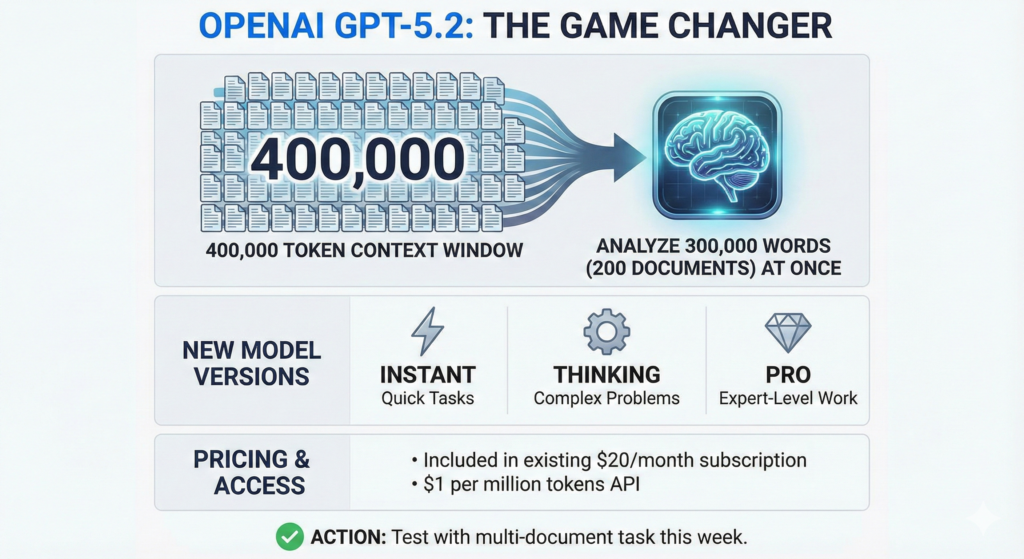
OpenAI released GPT-5.2 on December 11 in three versions: Instant (for quick tasks), Thinking (for complex problems), and Pro (for expert-level work). The new model can analyze 400,000 tokens at once—that’s roughly 300,000 words, or about 200 typical business documents.
So What? Does This Matter?
YES—if you use ChatGPT regularly for work.
The 400,000-token context window is the real game-changer here. You can now upload an entire quarter’s worth of reports, meeting notes, and emails, then ask questions across all of them. Previously, you’d need to summarize documents first or ask questions one file at a time.
The GPT-5.2 release was the week’s most important AI news December 2025 because it sparked a competitive rush among AI companies, proving that monthly AI model releases are becoming the new normal.
Real-World Example
A financial analyst uploaded earnings reports from 50 companies and asked GPT-5.2 to identify industry trends and unusual patterns. This used to take days of manual reading. Now it takes 15 minutes.
A marketing manager uploaded brand guidelines, competitor research, and audience data, then asked for a complete campaign strategy. The AI considered all three sources simultaneously instead of the manager having to connect the dots manually.
What It Costs
The API costs $1 per million tokens (about 40% more expensive than the previous version). For regular ChatGPT users, it’s included in your existing $20/month subscription.
Should You Do Anything?
Action: Try GPT-5.2 with a task you’ve been avoiding because it requires juggling multiple documents or sources. If you want to learn <a href=”/courses/essentials/chatgpt-mastery/”>ChatGPT mastery fundamentals</a>, our Essentials course covers this in depth.
Timeline: 30 minutes this week.
Skip this if: You don’t use ChatGPT regularly or your work doesn’t involve analyzing multiple documents.
Story #2: Google’s Gemini 2.0 Is Now Available to Everyone
The News
Google released Gemini 2.0 Flash on December 11. Unlike previous models that only worked with text, this one can create images, audio, and text. It also connects to Google Search, runs code, and works with third-party apps—all in the same conversation.
So What? Does This Matter?
MAYBE—if you already use Google products.
If you use Gmail, Google Docs, Android, or Chrome regularly, you’ll start seeing AI features appear in your workflow over the next few months. Google’s strategy is to integrate AI gradually into tools you already use rather than making you learn a separate AI tool.
Real-World Example
A product manager asked Gemini to research competitor features, create comparison charts with images, design presentation slides, and add audio narration for a stakeholder briefing. Everything happened in one conversation without switching between tools.
What It Costs
Free tier available. Paid plans start at $20/month for Gemini Advanced (similar to ChatGPT Plus).
Should You Do Anything?
Action: Nothing urgent. Google will integrate this gradually into products you already use.
Timeline: No action needed.
Skip this if: You don’t use Google products heavily, or you’re already committed to another AI ecosystem.
Story #3: AI News December 2025 – DeepSeek’s Cost Revolution
The News
Chinese AI company DeepSeek released V3.2 on December 1. It matches GPT-5 and Gemini 2.0 in performance but costs a fraction of the price. The company also released V3.2-Speciale, which achieved gold-medal performance in international math and coding competitions.
So What? Does This Matter?
YES—if you pay for AI tools or think AI is too expensive for your business.
For years, the best AI required expensive subscriptions to American companies. DeepSeek proved that open-source alternatives can now match the top models. Small businesses and startups can now afford AI that was previously only accessible to large enterprises.
Real-World Example
A healthcare organization deployed DeepSeek internally to analyze patient records. Because they can run it on their own servers, sensitive medical data never leaves their system. They’re getting GPT-5-level performance while maintaining complete data privacy and paying significantly less.
What It Costs
DeepSeek’s API pricing is dramatically lower than OpenAI or Google. The model is also open-source, meaning companies can run it on their own servers for free (though you’ll need technical expertise).
Should You Do Anything?
Action: If you pay $20-200/month for AI tools, spend 1-2 hours testing DeepSeek as a cheaper alternative. Calculate potential savings.
Timeline: This month.
Skip this if: You’re satisfied with your current AI tools and cost isn’t an issue.
Story #4: Enterprise AI News December 2025 – Microsoft’s Bold Move
The News
Microsoft announced 15-35% discounts on Copilot Business for companies with 10-300 employees. The promotion runs from December 1, 2025, through March 31, 2026. They also made Security Copilot available to Microsoft 365 E5 customers at no extra cost.
So What? Does This Matter?
YES—if you work at a small or medium-sized business.
Many small businesses couldn’t justify $30/month per person for AI tools. At 15-35% off, the budget objection disappears. Companies that said “AI is too expensive” last quarter might finally approve it this quarter.
This Microsoft announcement represents a major shift in AI news December 2025, signaling that enterprise AI adoption has reached an inflection point where affordability is no longer the barrier.
Real-World Example
A 50-person marketing agency got the Business Premium + Copilot bundle at 25% off. Each employee now saves 5-8 hours weekly on document creation, email management, and meeting summaries. That’s 250-400 hours saved company-wide every week.
What It Costs
- Standalone Copilot Business: $21/month (normally $21, now 15% off = $17.85)
- Business Standard + Copilot bundle: 35% off
- Business Premium + Copilot bundle: 25% off
Should You Do Anything?
Action: Talk to your IT team or boss about the Microsoft promotion before it ends March 31. If your company already uses Microsoft 365, this is an easy conversation. This pricing is particularly attractive for <a href=”/blog/ai-for-small-business/”>small businesses exploring AI adoption</a> for the first time.
Timeline: This month (before holidays when budgets get approved).
Skip this if: Your company doesn’t use Microsoft products, or you already have Copilot.
Story #5: Accenture and Anthropic: The Largest Enterprise AI Deployment
The News
Consulting giant Accenture and AI company Anthropic announced a partnership on December 9 to train 30,000 Accenture professionals on Claude. They’re also deploying Claude Code to tens of thousands of developers—the largest enterprise AI deployment to date.
So What? Does This Matter?
SORT OF—it signals that enterprise AI is real, not just hype.
When huge consulting firms train thousands of employees, it means their clients are demanding AI skills. Accenture wouldn’t invest millions in training unless companies were hiring them to implement AI systems. This is a leading indicator of where the job market is heading.
Real-World Example
Junior developers using Claude Code are producing senior-level output. They’re completing integration tasks faster and onboarding in weeks instead of months. Senior developers are shifting to architecture, validation, and strategy instead of writing routine code.
What It Means for You
If you work in tech, consulting, or professional services, AI literacy is becoming a requirement, not a nice-to-have. Companies want people who can use AI tools effectively, not people who can do everything manually.
Should You Do Anything?
Action: Add AI literacy to your professional development plan. Start using AI tools for real work tasks, not just playing around.
Timeline: Ongoing. Make this a 2026 skill-building goal.
Skip this if: You already use AI tools daily and feel confident with them.
Story #6: Trump Signs Order Blocking State AI Regulations
The News
President Trump signed an executive order on December 11 aimed at blocking states from enforcing their own AI laws. The order threatens to withhold federal funding from states like Colorado and California that have passed AI regulations.
So What? Does This Matter?
NOT YET—this is mainly political theater with legal battles ahead.
The U.S. Senate already rejected a similar proposal by a vote of 99-1. Legal experts expect significant litigation because states traditionally have broad authority to protect consumers and workers. Nothing changes immediately, but this creates uncertainty for companies trying to comply with regulations.
Real-World Impact
Companies that were using Colorado’s or California’s AI laws as a compliance framework now face uncertainty. Do they keep following state rules that might get overturned? Or do they wait for federal guidance that might never come?
Should You Do Anything?
Action: Nothing right now. If your company operates in Colorado or California and has been preparing for state AI laws, monitor this situation.
Timeline: Watch only. Any changes will take months or years.
Skip this if: You’re not in compliance, legal, or risk management.
Story #7: EU AI Act Compliance Deadlines Are Coming
The News
The EU AI Act’s first major deadlines hit in August 2025 for general-purpose AI (GPAI) models, with high-risk AI systems following in August 2026. Companies that build, deploy, or use AI systems in the EU must comply with transparency, safety, and human oversight requirements.
So What? Does This Matter?
YES—if your company builds or deploys AI systems in Europe, or if you’re in compliance/legal.
Unlike the U.S. executive order (which might get overturned), the EU AI Act is already law. First deadlines are eight months away. Companies that haven’t started preparing are running out of time.
Real-World Impact
If you’re in HR, compliance, or procurement and your company buys AI tools, you need to start asking vendors about EU compliance. If they can’t answer, that’s a red flag. <a href=”https://artificialintelligenceact.eu/” target=”_blank” rel=”noopener”>EU AI Act Official Documentation</a> provides the complete framework.
Should You Do Anything?
Action: If you’re in compliance or legal, spend 2-4 hours researching EU AI Act requirements and how they apply to your company’s AI use.
Timeline: This month. First deadlines hit August 2025.
Skip this if: Your company doesn’t operate in the EU and doesn’t serve EU customers.
Story #8: ChatGPT Adds Group Chat and Memory Features
The News
ChatGPT added group chat functionality, automatic memory management, and integrations with Adobe, Spotify, and Expedia. You can now share conversations with team members and ChatGPT will remember your preferences across sessions.
So What? Does This Matter?
YES—if you use ChatGPT with your team or family.
Previously, collaborating meant copying and pasting between people. Now you can share a conversation and everyone can contribute. The memory feature means ChatGPT remembers your role, your projects, and your preferences without you repeating context every time.
Real-World Example
A five-person content team created a group chat for their weekly blog planning. Each person adds ideas, ChatGPT tracks the conversation history, and everyone can see the full context. No more “did you see what ChatGPT suggested?” forwarding.
A parent set up a family group chat for vacation planning. Everyone adds their preferences, ChatGPT remembers dietary restrictions and budget constraints, and the whole family collaborates in one place. To learn more about using AI for <a href=”/blog/team-collaboration-ai/”>team collaboration</a>, see our guide.
Should You Do Anything?
Action: Turn on ChatGPT memory in settings. If you work with a small team, try group chat for a collaborative project.
Timeline: 15 minutes to set up.
Skip this if: You only use ChatGPT solo and don’t need collaboration features.
Story #9: AI Companies Failed Safety Standards in New Report
The News
The Future of Life Institute released a report on December 3 showing that AI companies’ safety practices fail to meet global standards. Even leaders like Anthropic, OpenAI, and DeepMind don’t meet basic safety requirements according to independent evaluators.
So What? Does This Matter?
NOT REALLY—this is an academic report with no immediate changes.
Researchers and safety advocates care deeply about this. For most professionals, nothing changes today. However, lawmakers might use this report to push for stronger AI regulations in 2026.
Should You Do Anything?
Action: Nothing immediate unless you’re responsible for AI safety at your company.
Timeline: Monitor only.
Skip this if: You’re not in AI governance, risk management, or policy roles.
Story #10: Concerning AI News December 2025 – Enterprise Trust Crisis
The News
A Harvard Business Review survey found that only 6% of companies fully trust AI agents to handle core business processes without human supervision. 94% of organizations require human oversight for any AI-driven decisions that significantly impact the business.
So What? Does This Matter?
YES—this explains why your company is cautious about AI.
If you’ve been frustrated that your AI proposals keep getting rejected, this is why. It’s not that leadership doesn’t believe in AI. They just don’t trust it yet for work that actually matters.
This trust gap is the most critical AI news December 2025 for anyone trying to get AI approved in their organization because it reveals the real barrier isn’t capability or cost—it’s confidence.
Real-World Impact
Companies are adopting AI for low-stakes tasks first: summarizing meetings, drafting emails, generating ideas. They’re not using it for hiring decisions, financial forecasting, or customer-facing communications without heavy human review.
Should You Do Anything?
Action: Next time you propose an AI project, address trust and oversight upfront. Show how humans will review AI outputs. Build in audit trails and clear boundaries. To overcome trust barriers, check out our <a href=”/blog/ai-governance-frameworks/”>AI governance framework guide</a>.
Timeline: Apply this to your next AI proposal.
Skip this if: You’re not involved in AI adoption decisions at your company.
Quick Reference: AI News December 2025 Summary
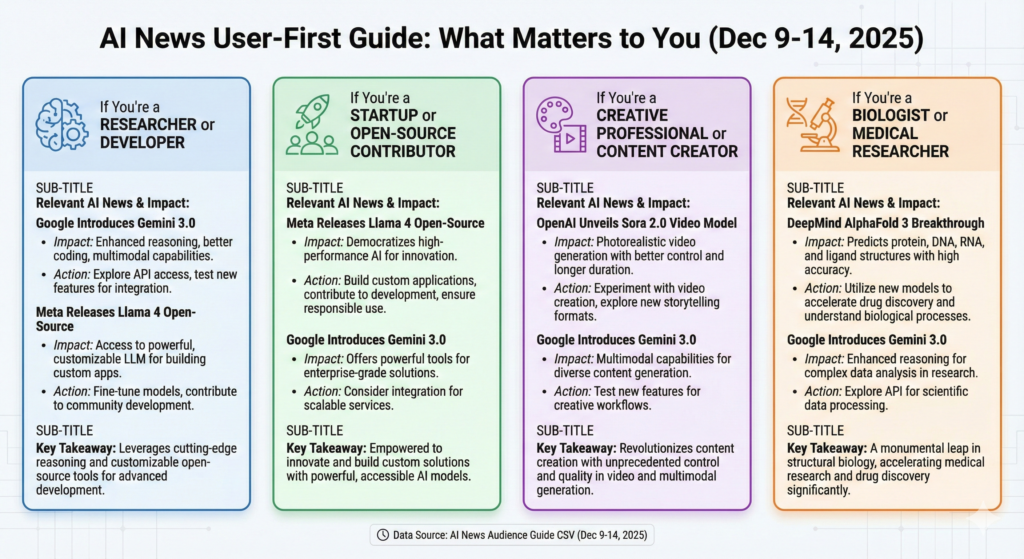
Here’s our complete breakdown of this week’s AI news December 2025 by audience segment:
✅ You Should Definitely Pay Attention If You Are:
Individual professional using ChatGPT
- Key stories: GPT-5.2 release, ChatGPT new features
- Action: Test GPT-5.2 with your hardest task. Enable memory feature.
Manager at small/medium business (10-300 employees)
- Key stories: Microsoft Copilot discounts, GPT-5.2 capabilities
- Action: Request demo of Microsoft Copilot before March 31 promotion ends.
Paying for multiple AI subscriptions
- Key stories: DeepSeek V3.2 cost savings, Microsoft promotions
- Action: Compare your current tools against DeepSeek pricing. Calculate savings.
Working in regulated industry (healthcare, finance)
- Key stories: EU AI Act, Trump executive order, safety report
- Action: Schedule 30-minute meeting with compliance team about AI Act timeline.
Learning & Development / HR professional
- Key stories: Accenture partnership, AI trust statistics
- Action: Add AI literacy training to Q1 2026 L&D plan. Budget for it now.
The Bottom Line: What Should You Actually Do This Week?
To summarize this week’s AI news December 2025: the competitive landscape is shifting, prices are dropping, and enterprise adoption is accelerating—but trust remains the critical barrier.
If you only have 15 minutes:
- Turn on ChatGPT memory in settings
- Try one conversation with the new GPT-5.2 model
If you have 1-2 hours:
- Test DeepSeek if you’re paying for AI tools (could save you 40-60%)
- Check if your company qualifies for Microsoft Copilot promotions
If you have 2-4 hours:
- Research EU AI Act requirements (if applicable to your business)
- Build an AI proposal with trust and oversight built in from day one
If you’re planning for 2026:
- Add AI literacy to your professional development goals
- Budget for AI tools and training in your Q1 planning
What This All Means: The Bigger Picture
Three major trends emerged from this week’s AI news in December 2025:
1. The “AI is too expensive” excuse is dying. Between Microsoft’s promotions, DeepSeek’s open-source models, and increasing competition, price is no longer the barrier. Companies that have been waiting for AI to become affordable just ran out of excuses.
2. Trust and oversight are the real barriers now. It’s not that AI can’t do the work. It’s that organizations don’t trust it yet. If you want to accelerate AI adoption at your company, address trust concerns first.
3. AI literacy is becoming a job requirement. When consulting firms train 30,000 employees, it signals client demand. Companies are hiring people who can use AI effectively, not people who can do everything manually.
The question is no longer “Should we use AI?” It’s “Which AI should we use, for what tasks, with what oversight?”
Want This Weekly AI Briefing?
Subscribe to get next week’s AI news December 2025 and AI updates delivered to your inbox every Monday. We cut through the hype and focus on what actually matters to busy professionals.
What you’ll get:
- 5-minute read every Monday
- Clear “does this matter?” guidance for each story
- Actionable steps with realistic timelines
- No technical jargon, no vendor hype
Your Questions Drive This
What did you think? Reply and tell me:
→ Which AI news December 2025 story matters most to YOUR work?
→ What AI question should I cover next week?
See you next Monday,
Jaspreet
P.S. Forward this to someone struggling to get AI budget approved. The Microsoft promotion might be their opening.

Recent Comments