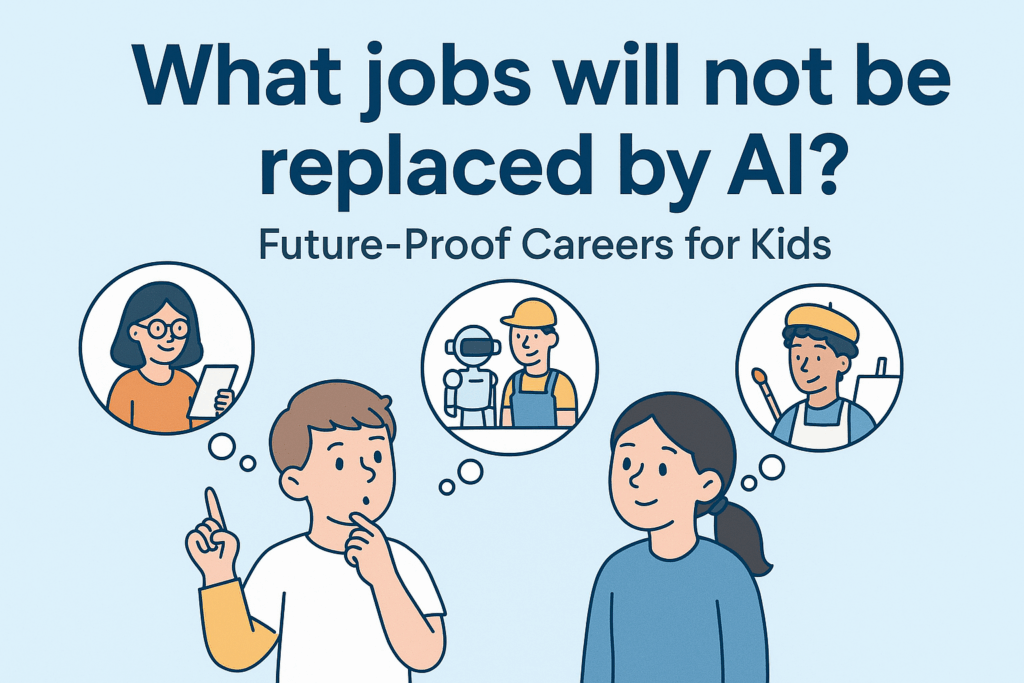
What careers will be safe from artificial intelligence and automation?
As artificial intelligence reshapes the employment landscape, parents face an unprecedented challenge: how do we guide our children toward future-proof careers that will thrive in an AI-dominated future? According to recent research from the World Economic Forum, artificial intelligence will replace some 85 million jobs by 2025, while simultaneously creating 97 million new opportunities that didn’t exist a decade ago.
The careers safest from AI automation are those requiring human judgment, creativity, physical dexterity, and personal interaction. According to comprehensive career analysis research, professions that rely on “uniquely human attributes like judgment, creativity, and personal interaction, which AI cannot replicate” will remain essential throughout the AI revolution.
How is artificial intelligence changing the job market for future workers?
Jobs most vulnerable to AI replacement
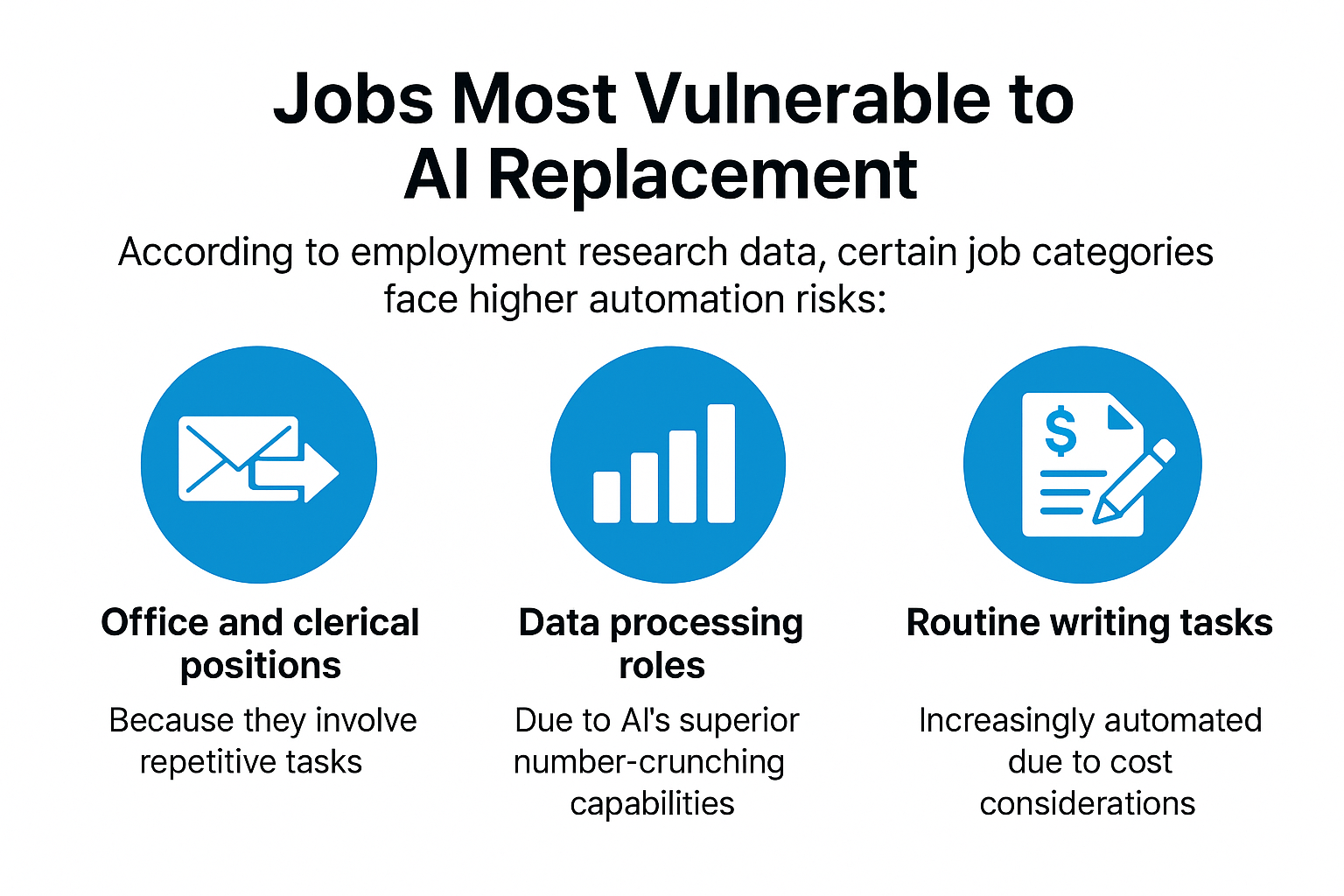
According to employment research data, certain job categories face higher automation risks:
Office and clerical positions are particularly vulnerable because they involve repetitive tasks that computing power can efficiently handle. As per industry analysis, lower-level administrative roles focused on “processing an InBox into an OutBox” are especially at risk.
Data processing roles face significant automation pressure. While AI serves as a powerful analytical tool, some experts warn that basic data analytics could be “ripe for being usurped by AI in the short/medium term” due to AI’s superior number-crunching capabilities.
Routine writing tasks, including basic content creation for SEO optimization and financial documentation, are increasingly automated due to cost-effectiveness considerations, according to career transition research.
The human advantage in AI-resistant careers
Despite AI’s growing capabilities, numerous professions remain strongly positioned because they require distinctly human skills that artificial intelligence cannot replicate effectively.
Understanding future-proof careers is essential as we navigate this evolving job market.
Which healthcare careers will remain secure in an AI-dominated future?
Healthcare consistently ranks as the sector least impacted by AI automation. As noted in career safety research, medical professions offer strong demand, excellent compensation, and inherent job security due to their human-centered nature.
Nursing: The most secure healthcare career path
According to the US Career Institute’s analysis, nurse practitioners represent the fastest-growing healthcare profession, with an estimated increase of 45.7% by 2032. Career research emphasizes that nursing provides “many opportunities, stability, and good pay, with options to specialize or work from home to avoid stressful bedside shifts.”
Advanced nursing roles offer exceptional career security:
- Certified Registered Nurse Anesthetist (CRNA)
- Nurse Practitioner specializations
- Hospital Administration positions
Technical healthcare specializations that AI cannot replace
These positions combine technical expertise with essential patient interaction:
Diagnostic Medical Sonographers perform ultrasounds requiring human interpretation and patient communication that AI cannot replicate.
Radiologic Technologists operate imaging equipment and interact directly with patients. While some express concerns about AI in radiology, industry analysis suggests that “human intervention for patient interaction and government regulations will keep these roles human-dependent for a long time.”
Cardiovascular Technologists and Respiratory Therapists provide hands-on patient care requiring real-time human judgment and adaptation.
Dental Hygienists combine technical dental knowledge with patient education and comfort—skills that require human empathy and communication.
Mental health professionals: The ultimate human-centered career
Social workers and therapists are particularly well-positioned for the AI era. As career analysis research highlights, these professionals provide essential “human-to-human interaction, empathy, and problem-solving, with diverse settings and good earning potential, especially with advanced licenses.”
Why are creative careers immune to AI automation?
Creative professions remain largely protected from automation because they require human judgment, original vision, and emotional intelligence that artificial intelligence cannot authentically replicate.
Visual arts and design: Where human creativity leads
According to comprehensive career research, while AI tools can assist with brainstorming and creating drafts, humans remain essential for “defining the original intent, design, making critical changes, and deciding when a work is complete.”
Graphic designers and digital artists will see their roles evolve rather than disappear. The research notes that “the human role shifts towards being a designer, curator, producer, critic, and opinion-maker.”
Architects combine creative vision with complex problem-solving, spatial reasoning, and client relationship management—capabilities that remain distinctly human.
Filmmakers and content creators require storytelling abilities, emotional intelligence, and cultural understanding that AI cannot authentically reproduce.
Music and performance: Irreplaceable human expression
Musicians, composers, and performers create art that resonates emotionally with audiences through lived human experience. While AI can generate music, it cannot replicate the authentic emotional connection that human artists create with their audiences.
Writing and communication: Beyond AI content generation
Professional writers will focus on high-level storytelling, strategic communication, and audience connection rather than basic content production. Human writers excel at nuanced communication, brand voice development, and creating content that builds genuine relationships with readers.
What skilled trades offer the best job security against automation?
Manual labor and skilled trades represent one of the most secure employment categories for the AI era. According to employment research, jobs requiring “dexterity, problem-solving in imperfect real-world environments, and hands-on technical work are difficult and expensive to automate.”

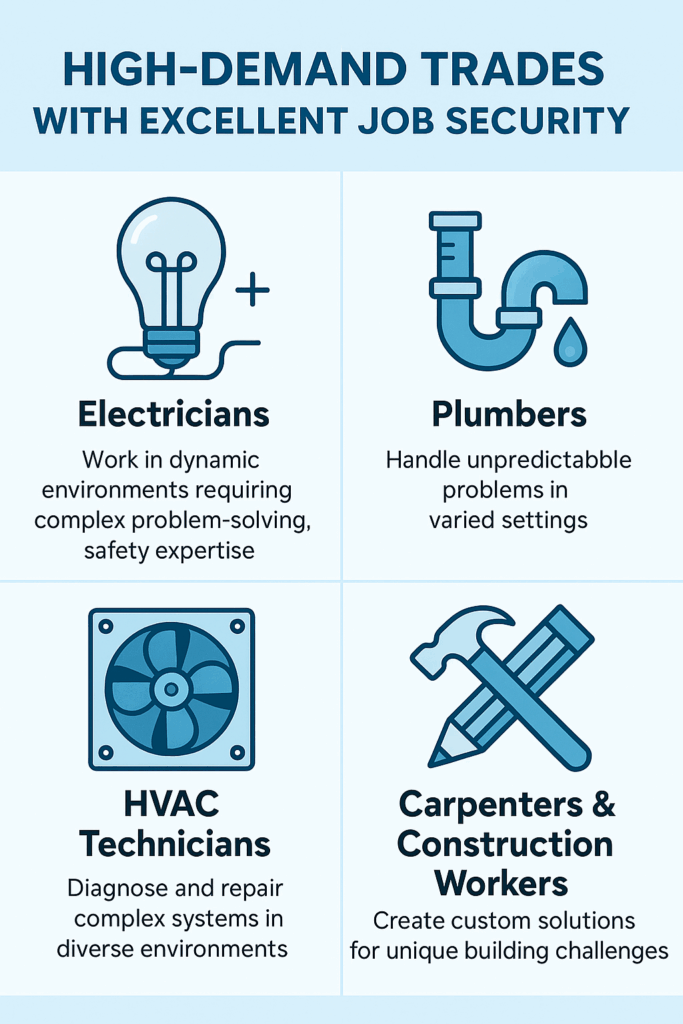
High-demand trades with excellent job security
Electricians work in dynamic environments requiring complex problem-solving, safety expertise, and adaptability to unique situations that robots cannot easily navigate.
Plumbers handle unpredictable problems in varied settings, combining technical knowledge with creative problem-solving abilities.
HVAC Technicians diagnose and repair complex systems while working in diverse environments that require human judgment and adaptation.
Carpenters and Construction Workers create custom solutions for unique building challenges that require human creativity and spatial reasoning.
Welders and Fabricators work with materials requiring precision, artistic skill, and real-time quality judgment.
Automotive and Diesel Mechanics diagnose complex mechanical problems requiring logical reasoning, experience-based intuition, and hands-on troubleshooting.
These professions offer significant advantages: they “often involve dynamic, non-repetitive tasks and can offer good pay and work-life balance,” according to career stability research. Many require only short-term vocational training or associate degrees, making them accessible career paths.
Equipment maintenance: The growing opportunity
As automation increases across industries, the demand for professionals who can maintain, repair, and optimize automated systems grows exponentially. This includes “mechanics for various equipment, including those that automate other jobs,” creating a meta-opportunity in the automation economy.
How will technology careers evolve in the age of AI?
Rather than being eliminated by AI, technology roles will evolve to focus on managing, optimizing, and collaborating with AI systems.
Software development: Enhanced, not replaced
According to technical career analysis, even as “AI eventually writes much of the code, humans will still be needed to translate complex human desires into clear and specific requirements, design user interfaces, conduct testing, refine outputs, and clarify the program’s objectives.”
The human role in software development will focus on:
- Requirements gathering and analysis
- User experience design
- System architecture decisions
- Quality assurance and testing
- Project management and client communication
Emerging AI-specific career opportunities
AI Prompt Engineers specialize in creating effective instructions for AI systems, bridging the gap between human intent and machine execution.
AI Ethics Officers establish guidelines for responsible AI implementation and ensure systems align with human values.
Machine Learning Operations Specialists manage the deployment, monitoring, and maintenance of AI systems in production environments.
AI Training Data Specialists curate and prepare datasets that teach AI systems to perform specific tasks accurately.
Data science: Strategic analysis beyond automation
While basic data processing faces automation pressure, strategic data science roles remain secure. According to recent career trend analysis, data science professionals focus on:
- Business strategy development
- Complex problem-solving
- Stakeholder communication
- Hypothesis generation and testing
- Ethical data usage oversight
What leadership roles will remain essential in an AI-driven economy?
Leadership positions requiring human judgment, relationship management, and strategic thinking will remain crucial throughout the AI transformation.
Political and policy leadership: Irreplaceable human judgment
Career research emphasizes that while “AI can analyze policy effects and strategies, human representatives are indispensable for making decisions about what is most appropriate for a given time, place, and population.”
Political leaders determine:
- Acceptable trade-offs in policy decisions
- Community priorities and values
- Ethical boundaries for technology implementation
- Resource allocation based on human needs
Educational leadership: Designing learning experiences
Teachers and educational administrators will see their roles evolve significantly. According to future career analysis, educators might become “mentors, learning experience designers, or even neuro-learning coaches.”
The research notes that “AI can provide accurate answers to questions, but human teachers are necessary for designing courses, determining the importance of topics, focusing on common mistakes, and assessing a student’s understanding and progress.”
Corporate management: People-focused leadership
Management roles involving people development, team building, and organizational culture remain inherently human. These positions require:
- Emotional intelligence for team management
- Strategic thinking for business development
- Relationship building with clients and stakeholders
- Conflict resolution and negotiation skills
How should parents prepare children for AI-era careers?
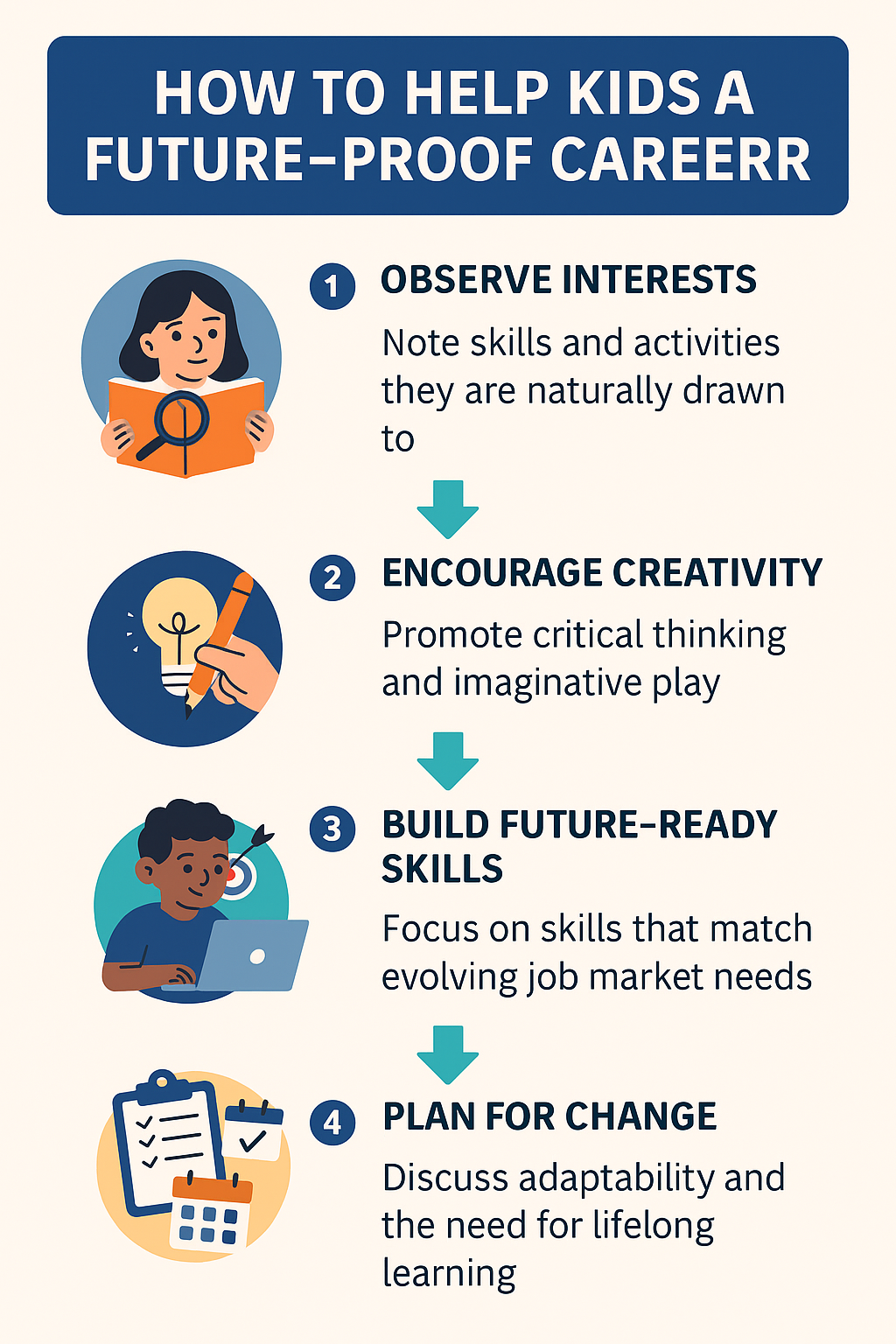
Focus on adaptability and lifelong learning
Career research emphasizes that “the person-job fit is dynamic and evolves over time.” Parents should encourage children to “build transferable skills and remain open to learning and growth, as careers will change” throughout their lifetimes.
Key transferable skills include:
- Critical thinking and problem-solving
- Communication and interpersonal abilities
- Creativity and innovation
- Emotional intelligence and empathy
- Technical literacy and AI collaboration skills
Prioritize skills development over traditional degree paths
Many high-paying, future-proof careers “can be attained with short-term vocational training, certifications, or associate degrees, often in two years or less.” According to employment research, “practical experience and hands-on skills are highly valued” often more than traditional four-year degrees.
Alternative education paths to consider:
- Trade school and apprenticeship programs
- Professional certification programs
- Community college technical degrees
- Online skill-specific training platforms
- Project-based learning and portfolios
Teach children to view AI as a collaborative tool
Rather than viewing AI as a threat, successful career preparation involves understanding how to leverage AI effectively. Future professionals will focus on “managing/directing various machines” and using “human discretion and judgment for higher-level decisions.”
Children should learn:
- How to effectively prompt and instruct AI systems
- When to rely on AI and when human judgment is essential
- How to verify and improve AI-generated work
- Ethical considerations in AI usage
Balance technical skills with human-centered abilities
While technical literacy is important, career guidance research recommends that individuals “prioritize the life they want to live before choosing a career, seeking roles that offer comfort, flexibility, and balance.”
Essential human-centered skills include:
- Emotional intelligence and empathy
- Creative problem-solving
- Leadership and team collaboration
- Cultural competency and communication
- Ethical reasoning and decision-making
What new career opportunities will AI create?
Emerging professional categories
AI Ethics and Governance Specialists establish guidelines for responsible AI implementation across organizations and society.
Human-AI Collaboration Consultants optimize the interaction between human workers and AI systems for maximum effectiveness.
Digital Wellness Counselors help individuals and organizations maintain healthy relationships with technology as it becomes more pervasive.
AI Explainability Experts make complex AI decision-making processes understandable to humans, crucial for regulated industries.
Synthetic Media Detectors identify AI-generated content and combat misinformation in an era of sophisticated AI creation tools.
Industry-specific AI integration roles
Healthcare AI Coordinators ensure AI diagnostic tools are properly integrated into patient care while maintaining the human touch.
Educational Technology Specialists design and implement AI-enhanced learning experiences that complement human teaching.
Manufacturing AI Technicians maintain and optimize robotic systems while ensuring quality control and safety standards.
Agricultural AI Analysts use AI for crop optimization, sustainability planning, and food security initiatives.
How will different industries adapt to AI integration?
Manufacturing and automation
While automation continues expanding in manufacturing, human roles are evolving rather than disappearing. According to industry research, positions requiring “dynamic, non-repetitive tasks” remain secure, while new roles emerge in:
- Robotics maintenance and programming
- Quality control and assurance
- Human-robot collaboration optimization
- Advanced manufacturing technology integration
Service industries: The human connection advantage
The hospitality and personal service sectors show strong resilience against automation. Career research indicates that roles requiring personal interaction and customization continue representing stable career choices:
Personal care services like hairdressers, cosmetologists, and massage therapists require human touch and personalized service.
Fitness and wellness professionals including personal trainers, coaches, and wellness consultants provide motivation, accountability, and customized guidance.
Hospitality management roles focus on creating memorable human experiences that AI cannot replicate.
Financial and business services evolution
While basic financial processing faces automation, strategic roles remain secure:
Financial advisors provide personalized guidance, emotional support during financial stress, and complex life planning.
Business consultants offer strategic thinking, relationship building, and industry-specific expertise.
Sales professionals excel at relationship building, complex negotiations, and understanding nuanced client needs.
Age-specific guidance for career preparation
Early childhood development (Ages 5-10)
Creative expression: Encourage art, music, storytelling, and imaginative play to develop creativity and self-expression skills that AI cannot replicate.
Problem-solving activities: Building blocks, puzzles, and hands-on projects develop spatial reasoning and logical thinking.
Social interaction: Group activities, team sports, and collaborative projects build interpersonal skills essential for future leadership.
Technology introduction: Age-appropriate exposure to technology without overwhelming dependency, focusing on creation rather than consumption.
Middle school exploration (Ages 11-14)
Career exploration programs: Job shadowing, career days, and informational interviews across diverse professions.
Skill development workshops: Maker spaces, coding clubs, art programs, and trade skill introductions.
Critical thinking development: Debate teams, science fairs, and research projects that require analysis and synthesis.
Communication skills: Public speaking, writing programs, and presentation opportunities.
High school specialization (Ages 15-18)
Internship and apprenticeship opportunities: Real-world experience in fields of interest.
Dual enrollment programs: College and vocational training options to explore different career paths.
Leadership development: Student government, club leadership, and community service projects.
Portfolio building: Projects, certifications, and achievements that demonstrate skills and interests.
Post-secondary planning strategies
Career path research: Investigation of education requirements, growth projections, and automation resistance for chosen fields.
Flexible education planning: Consider programs that offer both depth and adaptability for changing career landscapes.
Continuous learning mindset: Preparation for ongoing skill development throughout their career.
Network building: Mentorship relationships and professional connections in fields of interest.
Economic implications and future workforce outlook
Income and economic considerations
While AI promises increased productivity, career research notes concerns about “widening income gaps, potential structural unemployment, and the affordability of quality human services if AI options become cheaper.”
However, an optimistic perspective from economic analysts suggests that “widespread ownership of AI and democratic governance could prevent mass hardship by redistributing wealth and benefits.”
Transformation timeline and preparation window
According to McKinsey & Company research, generative AI could automate up to 30 percent of hours worked in the United States and 27 percent of hours worked in Europe by 2030. This timeline provides current children with ample opportunity to prepare for the changing landscape.
Key preparation strategies include:
- Starting career conversations early (middle school)
- Emphasizing transferable skills over job-specific training
- Building comfort with technology while maintaining human-centered skills
- Focusing on careers that complement rather than compete with AI
Frequently Asked Questions About AI-Era Career Planning
What jobs will not be replaced by AI in the future?
Jobs requiring human judgment, creativity, physical dexterity, and personal interaction are least likely to be replaced by AI. According to comprehensive career research, these include healthcare professionals like nurses and therapists, skilled trades such as electricians and plumbers, creative roles like artists and musicians, and educational positions. These professions rely on “uniquely human attributes like judgment, creativity, and personal interaction, which AI cannot replicate.”
Should my child learn coding if AI can write code?
Yes, children should still learn coding, but with a different focus than previous generations. According to technical career analysis, even as AI writes more code, humans remain essential for “translating complex human desires into clear requirements, designing user interfaces, conducting testing, and clarifying program objectives.” Future programmers will work alongside AI rather than compete with it.
How early should children start thinking about AI-resistant careers?
Career planning should begin in middle school (ages 11-14) with exploration activities, but specific career decisions can wait until high school. Career research emphasizes that “the person-job fit is dynamic and evolves over time,” so building transferable skills and maintaining adaptability is more important than early specialization.
Are college degrees still necessary for good careers in the AI era?
Not always. Many high-paying, future-proof careers “can be attained with short-term vocational training, certifications, or associate degrees, often in two years or less.” According to employment research, “practical experience and hands-on skills are highly valued.” The key is matching education level to career requirements rather than assuming four-year degrees are always necessary.
Which industries will create the most jobs as AI advances?
Healthcare, skilled trades, creative industries, and AI-adjacent technology fields will see the most job growth. According to industry analysis, roles that combine human skills with AI tools will be particularly valuable, including AI ethics specialists, human-AI collaboration consultants, and AI system maintenance technicians.
How can parents help children develop AI-resistant skills?
Focus on creativity, critical thinking, emotional intelligence, and hands-on problem-solving. Encourage activities that require human judgment, interpersonal communication, and creative expression. Career guidance research recommends balancing technical literacy with human-centered abilities like empathy, leadership, and ethical reasoning.
What if my child is interested in a career that might be automated?
Help them understand how that field is evolving rather than disappearing. Most careers will be transformed rather than eliminated. According to career transition research, the key is positioning themselves to work with AI tools rather than be replaced by them. Focus on the human elements of their chosen field that will remain essential.
Should children specialize early or stay generalist?
Stay generalist longer in the AI era. Career research emphasizes building “transferable skills and remaining open to learning and growth, as careers will change” throughout their lifetimes. Specialization can come later once they better understand how their interests align with the evolving job market.
How important is it for children to understand AI technology?
Very important, but not necessarily at a technical level. Children need to understand how to collaborate with AI, recognize its capabilities and limitations, and use it as a tool rather than fear it as a threat. According to educational research, “AI education doesn’t just prepare kids for high-tech careers but also provides a competitive edge in any field.”
What’s the most important thing parents can do to prepare children for the future job market?
Maintain an optimistic, adaptable mindset while building both technical literacy and distinctly human skills. Career guidance research recommends that parents help children “prioritize the life they want to live before choosing a career” while staying flexible about how they’ll achieve their goals as the job market evolves.
Conclusion: Thriving in the Content AI-Enhanced Future
The current era represents what career researchers describe as a “transformative age” and “Digital Industrial Revolution 2.0,” where continuous learning and adaptation become essential life skills rather than occasional requirements in our content AI-driven economy.
Rather than fearing content AI’s impact on employment, families should focus on understanding how to work alongside these technologies effectively. The research clearly shows that while content AI will transform the job market dramatically, it will not eliminate the need for human workers. Instead, it will shift emphasis toward uniquely human capabilities: creativity, empathy, complex problem-solving, and authentic interpersonal connection—areas where content AI still requires human guidance.
By focusing on careers that emphasize human judgment, personal interaction, hands-on skills, and creative thinking, parents can guide their children toward fulfilling and secure futures alongside content AI. The goal isn’t to compete with content AI but to complement it, creating a workforce where human intelligence and content AI work together to solve complex problems and improve lives.
As the research emphasizes, the focus should shift to “FIXING the robots, not working alongside them”—preparing our children to be the architects, managers, and guides of our content AI-enhanced future rather than passive observers of technological change.
The children who understand both the capabilities and limitations of content AI will be best positioned to thrive in tomorrow’s workforce, regardless of their chosen profession. Success will come to those who can leverage content AI as a powerful tool while bringing distinctly human value that no machine can replicate.
The future belongs to those who can combine technological literacy with human wisdom, technical skills with emotional intelligence, and analytical thinking with creative problem-solving alongside content AI systems. By starting these conversations early and maintaining flexibility as the content AI landscape evolves, we can prepare our children not just to survive but to thrive in the content AI-enhanced economy of tomorrow.
External Resources:
- World Economic Forum Future of Jobs Report
- McKinsey Global Institute on AI and Work
- Bureau of Labor Statistics Occupational Outlook
- National Center for Education Statistics Career Planning
Related Articles:

Recent Comments